Hiding assets in offshore or foreign bank accounts, is the focus of this "Asset Search News Roundup".  As I explained in "Using Multiple Jurisdictions To Launder Money", a common method of hiding assets is "putting assets offshore in one jurisdiction and exercising control over them through another".  Those using multiple jurisdictions to hide assets however, often also maintain offshore bank accounts as part of their schemes:

  • On November 21, 2008 hotel executive Stanley S. Tollman pleaded guilty to tax fraud charges.  Mr. Tollman had allegedly used offshore bank accounts from 1994 to 1999 in order to hide assets and income from the IRS.  According to "Hotel Executive to Pay $105 Million in Fraud Case", Mr. Tollman received a sentence of only one day of probation, but agreed to pay the U.S. Government $105 million as part of a plea agreement.
  • in "Key UBS exec indicted in tax scheme", The Miami Herald reported about the indictment of UBS executive Raoul Weil .  Prosecutors allege that Mr. Weil helped about 20,000 U.S. taxpayers conceal approximately $20 billion offshore during the years 2002 through 2007.  The November 24 article "UBS Clients Seek Amnesty on U.S. Taxes", also mentioned Mr. Weil’s indictment.  It further indicated that, (because of anticipated tax fraud investigations), some UBS clients hiding assets offshore have approached the IRS hoping for amnesty.

Copyright 2008 Fred L. Abrams

The victims of a securities fraud, divorcing spouses, post-judgment creditors, etc. can have several remedies available to them if they need to recover assets hidden offshore.  One might even pursue an asset search or recovery in the various offshore tax havens.  This is particularly true when a bank is used as a laundering “link” to hide funds in a money laundering circuit or assets have otherwise been hidden during a financial fraud.

To cite just one example, I have previously filed letters rogatory / legal assistance requests with the Court in Geneva, (“the “Parquet du Procureuer général), because of suspected money laundering at two Swiss banks.  As mentioned at “An Asset Search With Letters Rogatory“, these kinds of legal remedies can sometimes be used to elicit financial information from bank witnesses.

Other forms of relief for those seeking to recover funds hidden offshore, can range from attaching a bank account to alerting a financial intelligence unit.  Local counsel in Geneva has analyzed these legal remedies which are available in Switzerland and in many other jurisdictions across the globe:

“As you probably know, Switzerland does not follow the common law doctrine. We do not adhere to the institution of discovery. The usual tools available to a claimant are therefore the filing of a criminal complaint, which is actually the most efficient way to get past the banking secrecy. Access to the information will be granted only if someone can be indicted. In exceptional circumstances a broader access to the information collected within the frame of the criminal investigation can be granted on a discretionary basis.

Continue Reading An Asset Search In Geneva

This "Asset Search News Roundup" is about a former president detained because he may have hidden illicit assets by laundering them; a Bollywood film producer who pleaded guilty to conspiracy to commit money laundering; and a Pennsylvania jury deliberates over the case against an ex-Pennsylvania judge:

1)  As described at my post "White-Collar Crime", hiding assets sometimes leads to  criminal law violations. Such may be the case of former Taiwanese President Chen Shui-bian who could have hidden / laundered as much as $30 million in illicit assets along with nine other people.  According to "Taiwan Detains Chen on Suspicion of Money Laundering (Update1)",  the former president was detained by the Taipei District Court because of alleged money laundering, embezzlement and bribe taking.  The Taipei Times further reports Former President Chen is now at a hospital on a hunger strike, as his detention continues.

2)  The Washington Post and The Times of India mentioned the November 13th guilty plea of Bollywood film producer and the head of Elite Entertainment, Inc., Vijay K. Taneja.  As a Department of Justice press release also explained, Mr. Taneja pleaded guilty to one count of conspiracy to commit money laundering arising from his $33 million dollar mortgage fraud scheme.


3)  Timesleader.com reported that A jury began its deliberations yesterday, in the money laundering and mail fraud trial of ex-Pennsylvania Superior Court Judge Michael Joyce.  Based on news accounts, ex-Judge Joyce collected $440,000 in insurance monies by faking neck and back injuries from a 2001 auto accident.  The U.S. Attorney’s Office specifically alleged that Former Judge Joyce deposited the insurance proceeds into a brokerage account he used to purchase real property, an interest in a 1978 Cessna airplane and a Harley-Davidson motorcycle.   

Copyright 2008 Fred L. Abrams

Mr. Lattuga’s lawsuit against his wife is next scheduled for trial on Wednesday, November 19, 2008.  Mr. Lattuga claimed in it, that he had given his wife $784,822 because she had agreed to buy her father’s car dealerships for the two of them.  Mr. Lattuga specifically alleged that his wife had given the $784,822 to her father toward her $1.5 million purchase of C.D. Autos, Inc.  As part of the purchase, her father had even transferred all of C.D. Autos’ outstanding stock shares to her on January 2, 2001.

Mr. Lattuga’s lawsuit further alleged that his wife had intentionally defaulted / failed to pay her father the outstanding balance owed on C.D. Auto’s $1.5 million purchase price.  Mr. Lattuga also claimed that on June 29, 2004, his wife had transferred all of C. D. Autos’ stock shares back to her father because of her default.  On January 5, 2005, Mr. Lattuga’s wife finally filed for divorce.  She then argued during their divorce proceeding, that C.D. Autos, (and her father’s other car dealerships), were exempt from equitable distribution because she did not own them. 

Suspecting that his wife had fraudulently conveyed her stock in C.D. Autos, Inc. back to her father on June 29, 2004, Mr. Lattuga filed his above-mentioned lawsuit.  Based on Mr. Lattuga’s version of the facts, his wife’s June 29, 2004 stock conveyance had occurred without any consideration.  Furthermore, said stock may have been marital property subject to equitable distribution in the divorce.

While the Court dismissed part of Mr. Lattuga’s lawsuit in a February 26, 2008 decision, it still permitted him to proceed with some of his claims against his wife.  The Court found that Mr. Lattuga had pleaded a legally sufficient claim for both a constructive trust and a fraudulent conveyance under N.Y. Debtor and Creditor Law §276.  The Court reasoned that the wife’s alleged share transfer of June 29, 2004, could have "badges of fraud".  This was particularly true if Mr. Lattuga ultimately demonstrated that the share transfer was: without consideration; made in anticipation of the divorce; etc.

  
In its discussion of "badges of fraud", the Court relied on Wall Street Associates v. Brodsky, 257 A.D.2d 526, 529 (1st Dept 1999) and AMP Servs. Ltd. v. Walanpatrias Found., 2006 slip op. 7985 ; 34 A.D.3d 231; 824 N.Y.S.2d 37 (1st Dept, 2006).  These are the very same cases more fully described at my post "Badges Of Fraud In Debt Collection, Divorce & Bankruptcy".  As that post explained, the "badges of fraud" can sometimes be used to demonstrate that assets have been transferred with actual intent to defraud.

Copyright 2008 Fred L. Abrams

"Using Divorce To Dissipate Assets & Delay Creditors", explains that a debtor may use a divorce settlement to impede an asset search or forced collection proceeding.  This week’s "Asset Search News Roundup" is about a convicted murderer who may have used his divorce in this same way.  It also discusses some new Tax Information Exchange Agreements and how $182,000 had been hidden in the bathroom walls of a Cleveland home.

  • The November 8, 2008, New York Times article "Finding Cash in Walls, and Reaping Grief", reports that $182,000 in Depression-era currency was found by a contractor in the bathroom walls of a Cleveland home.

Copyright 2008 Fred L. Abrams

As I mention at “Searching For Nazi-Looted Art“, the most challenging asset searches / investigations can be those in a Holocaust-related art restitution case.  The October 30, 2008, Minneapolis Star Tribune article “MIA sends Nazi ‘loot’ home to Paris“, suggests the very same thing.  It explains that the Minneapolis Institute of Arts engaged in ten years of detective work regarding Fernand Leger’s “Smoke Over Rooftops”.  The Star Tribune article advises that “Smoke Over Rooftops” as Nazi-looted art, was recently returned to its claimants in Paris.  Also according to the article, “Smoke Over Rooftops” was purchased in 1951 from New York art dealer Mr. Curt Valentin and his Bucholz Gallery.

Although Mr. Valentin passed away in August 1954, he is portrayed in a number of different ways.  The above-mentioned Star Tribune article reports that Mr. Valentin’s “role in the transfer of modern art out of Europe is ambiguous at best“.  A biographical note at the Museum of Modern Art’s “Curt Valentin Papers” meanwhile, states that Mr. Valentin was “widely respected as one of the most astute dealers in modern art…“.  On January 13, 1941 Time Magazine even published “Domesticated Chisels” about Mr. Valentin’s Bucholz Gallery formerly on 57th Street in Manhattan.  In it, Mr. Valentin said: ‘Gallery business is sometimes fun, but I hate having to make money‘.

The 1994 New York Times letter to the editor “Nazi Loot Found Its Way to New York’s Modern Museum” however, alleges that Mr. Valentin / the Bucholz gallery was used as a middleman by MOMA to conceal its purchase of five antiquities at a Nazi auction in Lucerne.  Of the five antiquities, MOMA’s Provenance Research Project indicates that four of them had been looted by the Nazis from various museums.  MOMA acquired these four from Mr. Valentin’s Bucholz Gallery on April 13, 1939:

  1. Andre Derain’s “Valley of the Lot at Vers“;
  2. E. L. Kirchner’s “Street Scene“;
  3. Paul Klee’s “Around the Fish“;
  4. Henri Matisse’s “Blue Window“.

It is also true that art at Mr. Valentin’s Bucholz Gallery had been seized by U.S. authorities in 1944 pursuant to the Trading With The Enemy Act.  The art was seized on the ground that it was beneficially owned by a German enemy national.  Furthermore, Mr. Valentin had Nazi permission to sell art in America, as revealed by the November 14, 1936 letter reproduced below.

(Click On The November 14th Letter For Its English Translation)

 (Last edited October 21, 2010)

Copyright 2008-2011 Fred L. Abrams

An asset search may reveal assets concealed by a public corruption scheme; cash smuggling; or money laundering.  Accordingly, this "Asset Search News Roundup" examines the following:

(A)  On October 28, Massachusetts State Senator Dianne Wilkerson was arrested on a criminal complaint for public corruption.  As reported at "FBI: Photos Show Massachusetts Lawmaker Stuffing Bribes in Bra", federal agents allegedly recorded State Senator Wilkerson concealing bribe monies under her sweater, in her bra.  Twelve photos from the undercover operation can be viewed here.


(B)  U.S. border police searching two motor homes on October 26, found $38,780 which had been hidden at the Blue Water Bridge border crossing in Lake Huron, Michigan.  As a press release explained, the smuggled cash was concealed in: a safe built into a closest; a personal bag; a bathroom cabinet with a false floor; and in another compartment.  Just one day before the $38,780 was discovered, border police at the Blue Water Bridge interdicted $2 million in ecstasy pills hidden in a truck.     

(C)  "Risk-Based Approach for Casinos" and "Risk-Based Approach Guidance for Legal Professionals", were recently released / published at the website of The Financial Action Task Force.  The Financial Action Task Force is a leading transnational organization against money laundering.


Copyright 2008 Fred L. Abrams

Tax fraud is sometimes discovered when a divorce case is filed, a business dispute arises, a bankruptcy occurs, etc.  One statute applicable to many federal tax fraud prosecutions is 26 U.S.C. § 7201.  An example of such a prosecution is the indictment unsealed in the Southern District of Florida on September 10, 2007 in the case of Jorge Alberto Valdes.  There are however a number of other general tax fraud statues which may also be relevant to a tax fraud case.  According to the Internal Revenue Service, the following can be indications of tax fraud:

  • Deliberately underreporting or omitting income.
  • Overstating deductions.
  • Keeping multiple sets of books.
  • Making false entries in books and records.
  • Claiming personal expenses as business expenses.
  • Claiming false deductions.
  • Hiding or transferring assets or income.

As of December 20, 2006, rewards for confidentially reporting the above kinds of tax violations may be increased by the IRS Whistleblower Office to 15%-30% of the total proceeds the IRS collects.  26 U.S.C. § 7623 (b) {5} & {6} however, require that: the tax fraud or underpayment involve taxes, interest, and payments greater than $2 million; the tax violator’s annual income exceeds $200,000; and that the confidential tip be submitted to the IRS under the penalty of perjury.  According to both the "Whistleblower-Informant Award" webpage and a December 19, 2007 press release, a Form 211 must also be submitted to the IRS in order to qualify as an IRS whistleblower.

Furthermore, if a person can not satisfy all of the above requirements for a 20%-30% whistleblower reward, he or she might still be able to collect another kind of reward.  As explained by Publication 733 and 26 CFR 301.7623-1, the IRS sometimes pays discretionary rewards of up to 15%, (excluding interest), from what it collects because of confidential tips.  Pursuant to 31 CFR 103.62 the U.S. Treasury Secretary may also pay a reward of up to $150,000 where information about Bank Secrecy Act violations leads to the recovery of a civil penalty, criminal fine, or forfeiture over $50,000.  The Director of the FBI has similar authority to pay awards of compensation as mentioned by 28 CFR 8.3.

Finally, there are a number of ways to report a suspected tax fraud.  For example, one can provide a confidential tip to the IRS by submitting a Form 211 or by calling the Tax Fraud Hotline to report a return preparer fraud at 1-800-829-0433.  One can also send a letter or Information Referral (Form 3949-A) as outlined in "How Do You Report Suspected Tax Fraud Activity?".  Before providing a confidential tip about a tax fraud, it is however always best to first consult with an attorney.  Perhaps most important is that a person providing such a tip need not proceed before the IRS or other agencies alone and unprotected when reporting a tax fraud or other violations. This is true because one may participate in the Whistleblower or other reward programs while represented by an attorney of his or her own choosing.

Copyright 2007-2008 Fred L. Abrams

According to the Federal Bureau of Investigation, the concealment of bankruptcy estate assets is: "[t]he most committed offense in relationship to bankruptcy fraud investigations. Fraudulent filers understate the value of their assets so they can keep more of what they have amassed."  As pp. 59-79 of the United States Trustee Manual too recognize there are many different asset concealment schemes which are considered to be common bankruptcy frauds. 

For example, was a bankruptcy used as part of a "bustout", in which a business acquired goods on credit without the intent of ever paying for them?  Were a debtor’s assets omitted from bankruptcy schedules, as supposedly occurred in the case described at "Bankruptcy Estate Property Allegedly Concealed By A Cop"?  Have insiders depleted business assets long-term during a "bleedout", or has a pyramid scheme / investor fraud occurred?  Was a sham creditor concocted to file a proof of claim in the bankruptcy?  Could the debtor have fabricated other kinds of debt to make him / herself appear penniless throughout a bankruptcy proceeding?

A creditor trying to recover assets from a bankruptcy debtor should always ask the foregoing questions while pursuing the kinds of measures mentioned by "An Asset Search In A Chapter 7 Bankruptcy Case".  Ordinary measures can however, fail against a determined bankruptcy debtor who might use foreign bank accounts to conceal bankruptcy estate assets, as described at "Bankruptcy Fraud, Money Laundering & Hidden Assets".  Said determined debtor may use a nominee bank account and also take advantage of strong foreign bank secrecy laws.  

Even where a debtor hides bankruptcy estate assets by using a nominee bank account at a foreign bank, a creditor might still prevail.  If a creditor locates such a nominee bank account, the creditor can sometimes seek a court order directing the nominee bank signatory to supply an "authorization form" for the release of the debtor’s foreign bank records.  By presenting this "authorization form" to the foreign bank, the creditor would then conceivably gain access to the records for the debtor’s bank account.  

When a debtor hides assets in an offshore tax haven, it may also be necessary to seek the issuance of a letter rogatory / legal assistance request.  On rare occasions, a defrauded creditor might too file a civil RICO lawsuit against a bankrupt debtor hiding assets and claim "lost debt injury" pursuant to cases like Bankers Trust Co. v. Rhoades, 859 F.2d 1096, 1105 (2nd Cir 1988). 

While some debtors try to hide bankruptcy estate assets in foreign jurisdictions, others may instead rely on domestic bank accounts or businesses to facilitate their asset concealment schemes.  Such was the case of Mr. Jimmy Quan, convicted May 23, 2007 of: conspiracy to conceal assets,(18 U.S.C. § 371); bankruptcy fraud, (18 U.S.C. § 157); fraudulent pre-petition transfers or concealment, (18 U.S.C. § 152 {7}); false declarations, (18 U.S.C. § 152 {3}); and money laundering, (18 U.S.C. § 1956 {a} {1} {B} {i}). 

According to the Department of Justice, Mr. Quan’s bankruptcy creditors lost over $5 million because he had: diverted revenue from one of his companies to a business controlled by a family member; diverted revenue from yet another of his companies to businesses controlled by both he and his wife; and also laundered money through his child’s personal bank account. 

Copyright 2007-2011 Fred L. Abrams

Money laundering typically involves disguising the true beneficial ownership of funds or other assets which are the proceeds of crime.  Because money laundering often extends beyond just one nation’s borders, over 170 jurisdictions worldwide have adopted the anti-money laundering policies of the Financial Action Task Force.  Some nations also follow the anti-money laundering recommendations and/or policies of the Wolfsberg Group, the Basel Committee on Banking Supervision,  the Egmont Group, the European Union, or the United Nations.

Laundering circuits are sometimes used by: individuals protecting assets from lawsuits; spouses hiding marital property during a divorce; tax evaders hiding assets; debtors in bankruptcy concealing assets from creditors; terrorists financing their activities or other criminals concealing illicit proceeds.  Depending on the specific facts, any of the above activities could conceivably violate 18 U.S.C. §1956 (Laundering of Monetary Instruments); and / or 18 U.S.C. §1957 (Engaging in monetary transactions in property derived from specified unlawful activity); and / or 18 U.S.C § 1961 (Racketeer Influenced and Corrupt Organizations Act), along with other U.S. laws.

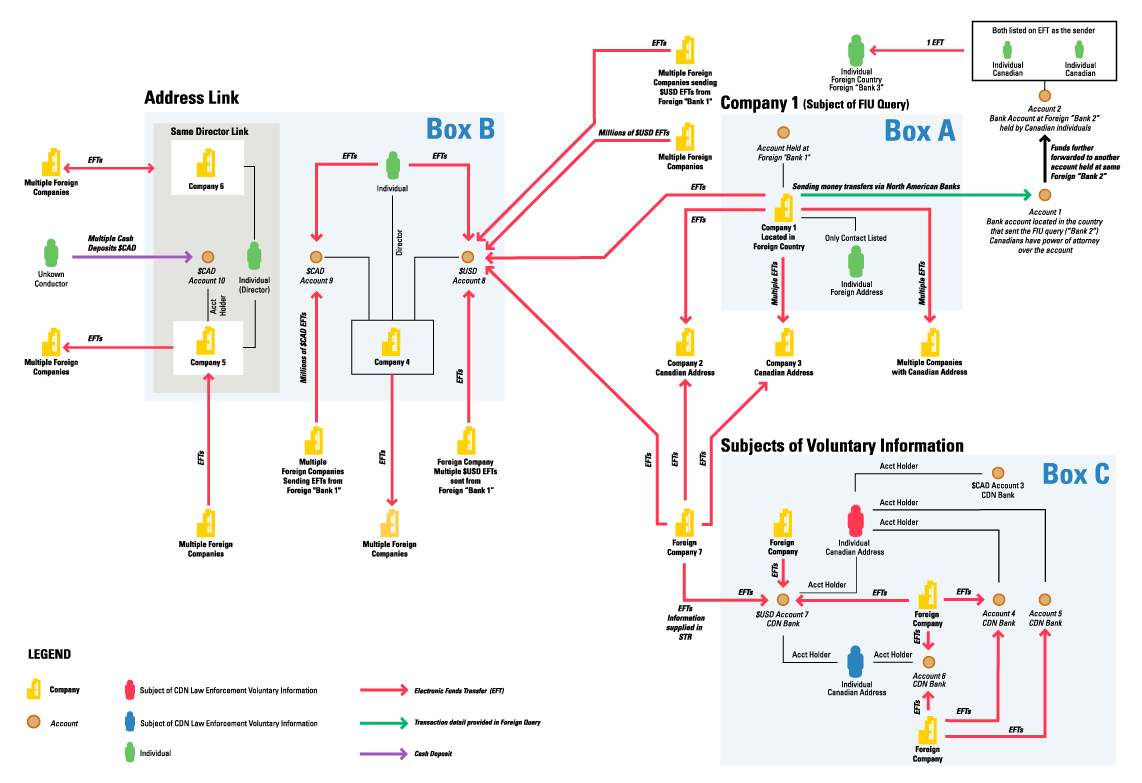
Money laundering is often described as occurring through placement, layering, and integration. Illegally obtained money is first placed into a financial system.  Layering then occurs as laundering links help disguise who the true beneficial owner of the money really is.  As the laundering “link chart” from FINTRAC the Financial Intelligence Unit based in Canada partly demonstrates: bank accounts, shell corporations, and nominees may all be used as laundering links which act as the protective layers of a money laundering circuit.  Many times laundering links are located in a Major Money Laundering Country and / or a tax haven where strong bank secrecy laws make them difficult to detect.

After it has been washed by a series of transfers between the laundering links, money in a laundering circuit is finally integrated into the financial system in the U.S. or elsewhere.  A back-to-back loan is one of the countless ways money is sometimes laundered.  It can be a loan which appears to be arm’s length, when in actuality the borrower and lender are one and the same.  In a back-to-back loan, the lender may secretly deposit cash offshore and then use this deposit to fully collateralize a loan to him / herself.

Although some of the details have been changed for privacy reasons, the chart below accurately depicts how the”Divorcing Spouse” employed a back-to-back loan to disguise the U.S. origin of funds.  As this chart reveals, the Divorcing Spouse laundered these funds by utilizing multiple jurisdictions and a fully collateralized loan.  First, the Divorcing Spouse secretly deposited $30 million in undeclared revenue into a Swiss bank account.  Based on the $30 million, the Divorcing Spouse secured a $29 million bank guarantee from the Swiss bank and used this bank guarantee to secure a $29 million loan from a bank in Germany.  After the German bank paid the Divorcing Spouse the $29 million loan principle, the Divorcing Spouse intentionally defaulted on the $29 million German bank loan. Because of the Divorcing Spouse’s default on the German bank loan, $29 million was finally transferred to the German bank pursuant to the Swiss bank guarantee.  As a consequence of the foregoing, the Divorcing Spouse washed the $29 million through the Swiss and German banks.  Furthermore, because of strict compartmentalization one would not ordinarily recognize that the Divorcing Spouse was  both the lender and borrower of the $29 million loan:


Copyright 2007-2018 Fred L. Abrams