Secreting Assets Without A Border Trace” shows the role portable valuable commodities like diamonds can have in a scheme to hide assets.  This January 4th “Asset Search News Roundup” reviews two more ways assets can be hidden.

Bulk Cash Smuggling

A December 16th press release refers to one case now being prosecuted which allegedly involved bulk cash smuggling and other crimes.  In these situations, currency or monetary instruments are physically transported / concealed in what is often a money laundering scheme.  An earlier “Asset Search Blog” article that discusses bulk cash smuggling in detail is “A Doctor, A Lawyer & Bricks Of Cash In Switzerland“.

Checks & Wire Transfers

Assets are also routinely hidden through the misuse of checks and / or wire transfers.  The article “A Tax Fraud & Identity Theft From Miami” for example, mentions a drug trafficker named Mr. Wallace.  Mr. Wallace had concealed $6.3 million dollars by wire transferring it from Panama to his Cayman Island bank account.

Nearly all of this $6.3 million was next stolen by Chuck who had forged letters to gain access to Mr. Wallace’s Cayman Island bank account.  Chuck specifically did this by impersonating Mr. Wallace in two letters he sent to the Cayman Island bank.  One of these letters redacted below, partly reveals that Chuck drained Mr. Wallace’s bank account by directing a wire transfer to Mexico:
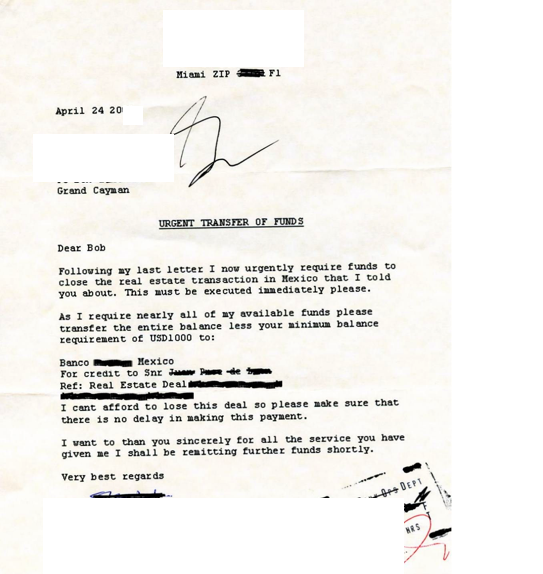

(To Read The Letter Click On It)

Copyright 2011 Fred L. Abrams

In his January 7, 2009 letter, Satyam Computer Services Ltd. founder and ex-chairman B. Ramalinga Raju wrote that Satyam had overstated its profits.  As a 2009 Reuters article observed, Mr. Raju’s January 7th letter indicated that approximately $1 billion or 94% of Satyam’s cash on its books was a fictitious asset.  This article also mentioned that Mr. Raju had written in his letter: "It was like riding a tiger, not knowing how to get off without being eaten.

Soon after Mr. Raju penned these words characterizing what is thought to be India’s largest accounting and securities fraud, he faced criminal charges.  As reported by India’s Economic Times, Mr. Raju’s criminal trial included testimony that he or his family members maintained 111 accounts at one HDFC Bank branch in India.  Besides uncovering such domestic accounts, investigating authorities in India tried to learn about any foreign bank accounts Mr. Raju beneficially owned

Indian authorities therefore issued a legal assistance request / letter rogatory to try to elicit financial evidence about funds Mr. Raju may have "diverted" and had possibly parked in U.S. banks.  Based on the facts alleged in this particular letter rogatory, Satyam funds could have conceivably been laundered through a number of U.S. bank accounts:

(To Enlarge Click On The Image Below)

Copyright 2010 Fred L. Abrams

Asset Search Blog articles quoting “Roger” the former foreign intelligence officer are “Following The Money Trail In Zurich” and “Offshore Bank Accounts In Liechtenstein“. The end of this article also features “Roger”, although its facts have been sanitized / changed for privacy reasons.

As a consequence of his U.S.-based Ponzi scheme, Bill the investment adviser was indicted for alleged violations of 18 U.S.C. § 1956 (money laundering); 26 U.S.C. § 7201 (tax fraud); 18 U.S.C. §§ 1341 and 2 (mail fraud); 15 U.S.C. §§ 78j(b) and 78ff(a) (securities fraud); and 15 U.S.C. §§ 80b-6 and 80b-17 (investment adviser fraud).

The critical question now was: What had happened to the $35 million dollars lost by the damaged investors in Bill’s Ponzi scheme? After Bill insisted he dissipated this $35 million by gambling and on cocaine, prostitutes, etc., federal agents interdicted $1 million U.S. dollars hidden in a bedroom wall at Bill’s California home.

Among the other items the agents seized during their search of Bill’s home, were Bill’s passport, desktop computer, cell phone, bank statements and jewelry store receipts. Some of these items revealed that Bill laundered $7.5 million of the damaged investors’ money through a nominee bank account opened in the name of a Nevada shell company.

Bill had eventually withdrawn this $7.5 million to purchase diamonds and other portable valuable commodities at Nevada jewelry stores He next traveled as an airline passenger to Zurich, Switzerland, according to his passport. To date, the only recovery from Bill’s Ponzi scheme has been the $1 million once hidden in his bedroom wall. Given all of the above, “Roger” explained how investigators could try to determine whether Bill had secreted any of the $35 million in a foreign bank account:

Bill’s purchase of the diamonds in Nevada and his travel to Zurich are money laundering red flags. Bill might have smuggled the diamonds into Zurich flying across U.S.-Swiss borders. Assuming Bill had flown to Zurich with the diamonds, he may have hired a driver with a car to pick him up at the airport. They might have then driven together through Northern France into Luxembourg.

In this possible scenario, Bill could have easily sold the diamonds in Zurich, (which is a major diamond centre), using the illicit proceeds to open a Luxembourg bank account. Alternatively, he may have opened an account at a Swiss bank which provides a service of security boxes (safes). In a security box he could leave the diamonds until such time as the pressure from the authorities had lifted.

Whatever happens, today Bill needs to produce a credit card for car-hire or a hotel stay. The credit card has to be issued by a bank, usually the bank where he maintains his security box and/or account with funds. The credit card expenses could also show the monthly debit for a security box and direct debit details if Bill has bought or rented property abroad.

By driving or taking a train into Luxembourg to open the foreign bank account, Bill could have traveled without leaving a border trace. Bill however, would still have likely committed at least some detectable errors. Bill for instance, may have left an electronic trace if he used a credit card to pay the driver and to buy gas for his car trip to Luxembourg.

If Bill stayed at hotels in Switzerland, France, or Luxembourg, he could have also paid his hotel bills with a credit card connected to a Swiss or other foreign bank account. If Bill used his hotel room telephone to communicate with a foreign bank witness, there would similarly be a record. These kinds of leads are reasons why money laundering investigations concentrate on foreign hotels, payment information, telephone records and on credit card expenses for details of physical movements and lifestyle.”

Copyright 2010-2022 Fred L. Abrams

Since a wide variety of persons conceal assets by money laundering, it is the topic of today’s "Asset Search News Roundup".

  1. Former U.S. House Majority Leader Tom Delay was convicted of state money laundering violations on November 24th.

    As described by "DeLay Is Convicted in Texas Donation Case", Mr. Delay was indicted on money laundering charges five years earlier.

    Said indictment asserted that Mr. Delay helped to illicitly transfer $190,000 in corporate donations through the Republican National Committee.

  2. Reuters says that six officers from a now defunct Missouri-based funeral business have been indicted for alleged money laundering and numerous suspected crimes.

    The superseding indictment returned against the six seeks to forfeit property such as the Hollywood Forever Cemetery.

    Hollywood Forever is the 62-acre burial ground for stars like Cecil B. DeMille, Jayne Mansfield, Rudolph Valentino and Douglas Fairbanks.

  3. A November 22nd news release described this month’s meeting of experts from the Financial Action Task Force and the Egmont Group.

    The Egmont Group’s "Cases" webpage featuring money laundering typologies, is especially informative.

    One of these typologies outlines the transfer of funds without "economic justification", which can be a laundering red flag:

Typology / Case# 08008: Courtesy of The Egmont Group

Copyright 2010 Fred L. Abrams

During A War Everybody Loots A Little Bit” stated thatmore than 20% of Europe’s art was believed to have been looted by the Nazis. Just some of this art was eventually recovered at or near: Vicenza, Italy; Linz, Austria; the home of the Nazi Governor-General of Poland; the Seigen copper mine in Germany; and the salt mines of Merkers, Germany.

Of these Holocaust-era recoveries, the one at the Merkers salt mines was the most remarkable. Among the looted items the Nazis hid in the salt mines, was nearly 25% of the Berlin Museum’s art collection. Hidden in these mines with art by Raphael, Durer, Renoir and Rembrandt, were 208 suitcases and bags. They were filled with jewelry, dental gold, etc. looted from concentration camp victims. One hundred tons of gold bars had too been concealed in the salt mines.

Nazi Gold: The Merkers Mine Treasure” reveals that 400 tons of art were also interdicted there. U.S. Third Army troops recovered these looted assets at the salt mines in April 1945. This recovery is documented by Colonel Bernard Bernstein’s July 23, 1975 oral history transcript. The transcript mentions that a wall in the mines had inscribed on it, “The State is everything and the individual is nothing.” The transcript additionally discusses the April 12, 1945 tour of the mines by U.S. Generals Eisenhower, Patton and Bradley:

Generals Examining Looted Art In The Salt Mines*

Perhaps the most compelling question is: What happened to all of the Nazi-looted art that was never recovered from WWII? The 1991 Newsweek article “The Heist Of 1945” reported that the Russian Army’s “Trophy Commission” confiscated a lot of it. Suspected Nazi-looted art meanwhile, is sometimes the target of holocaust-era art restitution claims.

The claimants in these litigations typically assert an action in replevin against the present-day possessors of the alleged Nazi-looted art. The July 27th complaint filed in Csepel v. Republic of Hungary, No. 1:10-cv-01261, (D. D.C.), contains this kind of claim. Bakalar v. Vavra, Index No. 05-cv-3037 (S.D.N.Y.), as described by “In New York, A Thief Can Not Pass Good Title“, also involves a replevin claim.

Yet another Holocaust-era art restitution claim asserting replevin was Grosz v. The Museum of Modern Art,1:09−cv−03706 (S.D.N.Y.). Even though the trial court issued its January 6, 2010 order dismissing the Grosz claim, Grosz is scheduled for a December 8, 2010 oral argument on an appeal. Two court filings from the Grosz case can be viewed by clicking on the images below:

*Photo of U.S. Generals:National Archives and Records Administration

Copyright 2010 Fred L. Abrams

Tax transparency, three African heads of state and Peruvian cultural artifacts, are the subjects of the November 15, 2010 “Asset Search News Roundup”:

  1. Tax Transparency: Presentation of the Report on progress made against international tax evasion” published by the OECD, stressed the critical role of cross-border cooperation in fighting international tax fraud.  IRS Commissioner Doug Shulman’s June 8, 2010 speech to the OECD similarly emphasized the need for international cooperation.  The speech argued that a company with cross-border activities should be jointly audited by interested tax authorities from across the globe.
  2. Three African Heads of State Sued For Hiding Assets” described the December 2, 2008 misappropriated assets lawsuit filed against President Denis Sassou-Nguesso, President Obiang Nguema and the late President Bongo.  This lawsuit commenced in France by the Sherpa Association and Transparency International, accused the three of concealing assets allegedly derived from corruption schemes in Africa.  As set forth by a November 9th press release, the French Supreme Court just ruled that Transparency International was a proper party in the lawsuit.
  3. Government Settles With Art Collector, Allowing Two Rare Ceramic Antiquities To Be Repatriated To Government Of Peru” is about Peru’s anticipated recovery of antiquities seized at NY’s John F. Kennedy International Airport in August 2009.  These Peruvian antiquities were interdicted upon their arrival from Switzerland and their provenance had reportedly been falsified through phony invoices.U.S. government press releases dated December 11, 2009, February 11, 2009 and June 2, 2010 reveal that a number of different Peruvian cultural artifacts have already been repatriated to Peru.  At an April 7, 2010 ceremony, U.S. officials had also returned to Peru the smuggled pre-Columbian human skull pictured below and eleven additional ones.  The 1,400-year-old skulls were discovered in January 2004 by two Cleveland, Ohio warehouse workers who had accidentally dropped a crate which supposedly contained just ceramic masks.

    Photo: Courtesy Of ICE

Copyright 2010 Fred L. Abrams

"Illegally Accessing Customer Information At U.S. Banks" characterized the Gramm-Leach-Bliley Act as a U.S. bank secrecy law.  On the one hand, it and other bank secrecy laws around the world protect the privacy of bank customers entrusting financial information to banks.  On the other hand, bank customers can easily abuse these laws during a fraudulent asset concealment scheme.

To cite just one example, a New York divorcing husband might conceal marital assets in anticipation of an equitable distribution hearing, by transferring them out of New York into a secret Swiss bank account.  The divorcing husband may think the marital assets in his Swiss account will remain undetected because as a bank customer, he would ordinarily be protected by Swiss bank secrecy laws. 

Despite the existence of these bank secrecy laws, the divorcing wife could gather financial intelligence to conceivably identify the Swiss bank witness maintaining this Swiss account.  The divorcing wife would then be able to compel the Swiss bank witness to disclose the divorcing husband’s bank customer information, pursuant to the bank secrecy law exception outlined at "Foreign Bank Secrecy Laws & An Asset Search".

Through the above-described type of marital asset search, the divorcing wife can pierce the bank secrecy veil used by the divorcing husband in his fraudulent asset concealment scheme.  Under these circumstances, the divorcing wife would actually have a broad range of legal remedies available to her, as set forth by "An Asset Search In Geneva".

Copyright 2010 Fred L. Abrams

The October 27th “Asset Search News Roundup” covers Former Premier Michael Misick and tax fraudster Erwin Mayer:

One such land grant concerned 18 acres located in the North West Point area of the Turks and Caicos Islands, highlighted on the map below.  Regarding this land grant, the final report to the Commission of Inquiry claimed Michael Misick:  “…was the beneficiary of a number of land grants, including one of 18 acres in the North West Point area in April 2007, for which he did not pay.  His partners, overseas developers, paid the entire purchase price of over $1.9 million, but he received 50% ownership in the project.


(For Hi-Res Click On The Map)

Copyright 2010 Fred L. Abrams

Kleptocrats hiding assets in Swiss banks and investors subject to clawback claims in the U.S., may have something in common. Each could conceivably bear the evidentiary burden of proof in asset recovery cases brought against them. The Swiss Restitution Of Illicit Assets Act (“RIAA”) for example, shifts the burden of proof onto crooked politically exposed persons or suspected kleptocrats.

As explained at “Recovering Assets In Switzerland Hidden By Dictators“, the RIAA freezes a kleptocrat’s assets by presuming said assets are from a public corruption scheme. When a kleptocrat’s assets are frozen pursuant to the RIAA, the kleptocrat bears the burden of proving his / her assets have legitimate origins:

(Click Below For A Full View Of The RIAA)

A U.S. court similarly shifted the burden of proof in one particular asset recovery case involving the clawback of investors’ profits. As more fully set forth by “Clawback Caused By A Ponzi Scheme“, the Bayou Court placed the burden of proof onto investors thought to have acquired profits from a Ponzi scheme / securities fraud. The Bayou Court shifted the burden of proof by asserting in its October 16, 2008 Decision, that the investors had been the transferees of presumptively fraudulent assets.

The Bayou Decision and the RIAA are however, both contrary to the ordinary rule requiring governmental authorities or other claimants to bear the burden of proof during an asset recovery. Perhaps most important is that Bayou and the RIAA raise today’s question: Will shifting evidentiary burdens of proof become a future asset recovery trend?

Translated Copy Of RIAA: Courtesy Federal Dep’t Of Foreign Affairs

Copyright 2010 Fred L. Abrams

This “Asset Search News Roundup” is about a few companies currently offering asset protection over the Internet. The first of these companies is Panama Legal, S.A.  Its Web site says that “Bullet Proof Asset Protection” is attainable by forming a “Panama Bearer Share Corporation“.  “Bearer Shares & An Asset Search“, meanwhile mentions that bearer shares may be used with shell companies, multiple jurisdictions, etc., to launder money.

Capital Asset, Inc. is yet another company marketing asset protection through the Internet.  It seems to especially display contempt for the rule of law, as indicated by “If A Judge Can See Your Assets, He Can Seize Them“.  Its Web page entitled “Asset Protection For Doctors”, corroborates this point by stating: “The only way to guarantee you cannot lose anything to a lawsuit is to have asset protection where no judge or attorney can find or see what you own, thus they cannot seize your assets.

Asset Protection Alliance, Inc. also refers to the judiciary in its asset protection Web page: “Remember, if a federal judge can find an asset, he can seize it. Conversely, what he can’t find, or doesn’t know about, he can’t touch.”  This Web page too supplies a fact pattern which, (under certain circumstances), could be a money laundering typology.  According to the fact pattern, a beneficial owner named “Gino” allegedly has no IRS tax or other worries because he apparently conceals his assets via an offshore debit card, nominees and a foreign bank account.

Copyright 2010 Fred L Abrams